





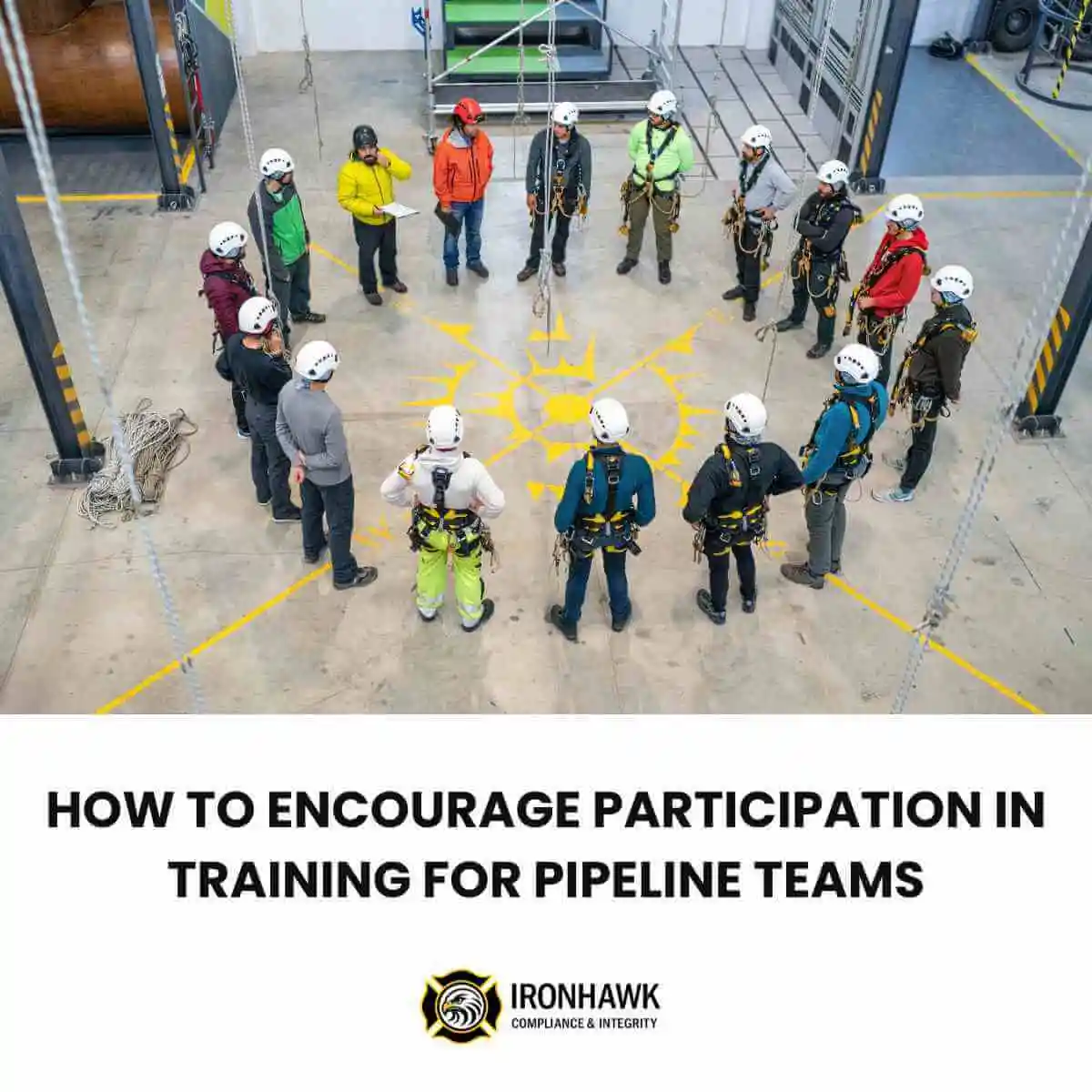
If you’ve ever led a pipeline safety or technical training session, you’ve likely faced teams with all of the telltale signs. Their arms are crossed, eye contact is at a minimum, and responses after asking a question are nonexistent. Encouraging participation in training can be difficult at times, but when your session is structured in a way that makes engagement natural, teams feel the impact.
EHS training is the core of any great safety culture. It’s the foundation that provides teams with the tools and understanding they need to operate in high-hazard work environments. Take a closer look at how to effectively keep teams engaged and learning life-saving skills.
How to Encourage Participation in Training Without Forcing It
Participation starts with design. If you want people to be engaged with your training, you need to create a lesson that is built around participation rather than passive listening.
For example, if your presentation relies heavily on slides and a lecture, crews default to passive listening. In technical environments, engagement increases when instruction shifts from presentation to problem-solving.
Instead of reviewing procedures line by line:
- Present a real-world scenario from pipeline operations.
- Ask, “What would you do first?”
- Break down a near-miss and let the group identify failure points.
- Turn compliance language into decision-making exercises.
Role-based questions are especially effective:
- “What should maintenance verify here?”
- “Where does supervision step in?”
- “What could the operator miss?”
This approach reduces pressure on individuals while encouraging practical discussion tied to actual field conditions.
How to Engage Quiet Crews in Technical Training
Quiet crews are not always disengaged, as they may be cautious about speaking publicly, taking in the information, or simply have nothing to add to the conversation.
However, even when the room feels silent, there are still ways to get quieter participants to respond, engage, and contribute to your training efforts:
- Break larger groups into smaller discussion clusters.
- Ask groups to report back collectively instead of calling on individuals.
- Assign rotating “risk identifier” or “devil’s advocate” roles.
- Keep training fun and engaging by using real-world scenarios and hands-on discussion tied to daily work.
In pipeline and industrial settings, many workers respond better to applied examples than abstract instruction. When the discussion centers on real equipment, actual maintenance cycles, or recent industry incidents, participation increases.
Engagement grows when the content reflects their world. This is why it’s critical for those leading safety meetings to have an active understanding of not just policy and procedure, but how operations work in real life.
How to Work With Experienced Crews Who Think They’ve “Seen It All”
One of the biggest participation barriers in safety training isn’t resistance, like you might initially think. Rather, there are groups who have become complacent or overly confident as a result of experience.
There are some experienced workers who may feel they already know the material, as repetition breeds disengagement.
It doesn’t matter if it’s a child sitting in middle school or a manager with 25 years of pipeline experience in the field. Eventually, you’ve seen a lot, which may make you think you’ve seen it all.
It’s human nature to become disengaged, bored, and hold back on participating. However, instead of challenging the knowledge of your students, inviting their experience is a great way to keep them involved:
- Ask them to share lessons learned from past incidents.
- Present advanced “what-if” escalation scenarios.
- Turn them into peer educators for newer employees.
- Ask how procedures have changed over the years.
Framing participation as mentorship shifts the tone. Experienced workers are more likely to engage when their knowledge is respected rather than tested.
At the end of the day, this keeps everyone involved and provides a platform for adding new knowledge to the discussion in a healthy manner.
How to Handle Difficult Participants in Safety Training
Every instructor eventually encounters a disruptive or resistant participant. It comes with the territory.
But knowing how to handle difficult participants in training requires control without escalation and an understanding that resistance often isn’t personal.
Sometimes the individual didn’t choose to attend. Sometimes they feel the content is repetitive. Sometimes they’re frustrated by pressures outside the room.
Either way, it’s the instructor’s job to teach and reach these individuals. Effective approaches to handling difficult students include:
- Redirecting negative comments into constructive discussion.
- Asking for their experience instead of challenging their attitude.
- Acknowledging skepticism without surrendering authority.
- Separating behavioral correction from public confrontation.
- Following up privately when necessary.
In high-hazard environments, public power struggles rarely end well. Crews quickly assess whether an instructor understands field realities and maintains composure under pressure.
When the trainer has lived the work and remains steady, resistance often shifts into contribution.
Conflict rarely resolves through dominance. It resolves through competence and control.
Encouraging Participation in Training Depends on Instructor Credibility
Ultimately, engagement is more than just the tactics you deploy. Instructors need to establish trust and credibility and to facilitate a platform conducive to engagement for many different types of students.
Crews participate when they believe:
- The instructor understands real operational pressures.
- The scenarios are grounded in actual pipeline or industrial conditions.
- The training reflects field experience, not textbook theory.
Technical training programs must integrate both hard skills and soft skills. Decision-making under pressure, communication across roles, and stop-work authority all influence participation levels.
At IronHawk Compliance & Integrity, our technical training programs and pipeline safety training are delivered by industry veterans who have operated, supervised, and managed in high-risk environments.
Our instructors aren’t just leading classroom discussions or reading off a computer. Our team has lived the experience in the field, understands crews, and has the skills to deliver engaging training that sticks.
Encouraging participation in training starts with creating sessions that feel relevant, credible, and grounded in the work they perform every day.
Featuring more than 100 years of in-the-field experience, IronHawk delivers a unique approach to EHS topics.
Contact us today and learn more about how we help transform training sessions into an empowering framework for your safety culture.
Sources
Harvard GSE. Accessed February 2026.
TrainSMART. Accessed February 2026.